

REFLECTION: Embodying Resilience
- Sheila Sandow
- Jan 29
- 5 min read
Updated: Mar 5


I knew this month's congregational theme started with the letter "e," but I kept calling it embracing resilience instead of embodying resilience. So I consulted my AI guru to see what the difference might be between the two:
Embracing implies accepting, adopting, or holding something (like a belief or identity) closely, often at an internal or conceptual level.
Embodying goes deeper, representing the tangible, lived expression of those values through actions, behaviors, and physical presence—essentially becoming the living embodiment of the concept.
No problem! Surely I am able to go deeply to the core—embodying resilience and not just embracing it. But the more I read about resilience this month's *Ministry Packet*, the more I recognize I have work to do before I can fully embody resilience.
That work starts with my (mis)understanding of how one manifests resilience.
"When did we decide that resilience was a solo project?" asks Rev. Scott Tayler, Soul Matters founder, at the beginning of this month's Overview. From childhood on, he explains, our society teaches us that resilience is a solo act. Consider these familiar phrases we were all raised to believe:
"Pull yourself up by your own bootstraps."
"You're stronger than you think."
"If at first you don't succeed, try, try again."
"What doesn't kill you makes you stronger."
"You can do it!"
Author and activist Soraya Chemaly tells us that our society's vision of resilience "highlights and glorifies self-sufficiency, limitless positivity, and individual strength against all odds," instead of the "interdependence, collective versatility, and shared care" which she identifies not only as "our greatest resilience assets," but also essential in a world that seems to be collapsing into conflict.
Rev. Tayler points out that we need not entirely reject the old messages about personal resilience completely, but they may get in the way of learning that we need each other now more than ever before. "...[W]hile resilience has a lot to do with what is inside us, it is even more dependent on what is between us," he writes. "Internal and individual grit only gets us so far; empathy, assurance and love from others gets us the rest of the way."
There really is no such thing as a resilient person.
[T]here are only resilient relationships,
from which resilient people arise."
– Rev. Scott Tayler
And therein lies the rub:
I have lived my life convinced I can "go it alone," that needing others' help—perhaps even leaning upon others from time-to-time—is not only unnecessary, but most likely a sign of weakness. Now I am beginning to understand that such fierce independence no longer serves me well. In today's world, we all need to live interdependently.
But how do we learn to do that? The Spiritual Exercises included in this month's *Embodying Resilience Ministry Packet* provide helpful pathways to that learning.
One of this month's exercises suggests we Write a Failure Résumé. "[T]ruly resilient people don't run away from failure; they learn and embrace it," say our friends at the Soul Matters Sharing Circle. "Instead of treating failures and mistakes as setbacks…, failure résumés frame them as sources of growth that offer us many gifts." They enable us to say: "If any of this happens again, I will be okay" and "I am allowed to be a work in progress." Soul Matters suggests that while there are many ways to write a failure résumé, it's important to always acknowledge what we have learned from each failure, what gift(s) it gave us.
Perhaps the most important aspect of resilience is to keep going. This month's Your Way to Keep Going? exercise helps us determine our best strategies for keeping going, not just when the going gets rough, but also when we tire of routine. Although our methods to keep going are likely to be very personal, it can be helpful to read the keeping-going strategies recorded by writer Lisa Olivera in her "How to Keep Going Manifesto." Here are some of her methods that particularly resonate for me:
"Stop trying to get somewhere else. There is nowhere else to get to….
"Drive below the speed limit in especially beautiful places…. [L]et it remind you of how you want to be, of how you want to see.
"Instead of always trying to rise above it, let your anger remind you of what you want for yourself, for everyone else….
"Keep tabs on all the ways you’ve been taught to do things alone…. Give yourself permission to unlearn ways of being…that go against what it means to love…. Lean into the discomfort of requiring support.
"Allow your expectations of yourself and others to be fluid instead of rigid. … Let what you and others are capable of shift as life does.
"Stop striving for extraordinary. … Let ordinary remind you of what really matters.
"… See what happens when you de-center your own singular life and show up for the pains and joys of other people.
"Notice the places you’re actually capable of making changes but are trying to convince yourself you’re not. ….
"… Let your heart open more. Then some more. ….
"Trust nothing will fall apart if you stop taking it all so seriously.
"Remember that everything will change, more times and in more ways than you can imagine. … Be open to it so it can find you. …."
Another spiritual exercise that caught my being this month is called Visio Divina & Resilience. "Visio Divina (spiritual seeing) is an ancient religious practice where one lets images become doorways through which the divine, our inner wisdom or life itself speaks to us," say our friends at the Soul Matters Sharing Circle. This exercise provides us with a selection of "resilience" photos, suggesting we pick one or two that speak to the resilience in our lives, then explore how the image(s) we've chosen offer a message of comfort or challenge. Here are two images that spoke to my own resilience:

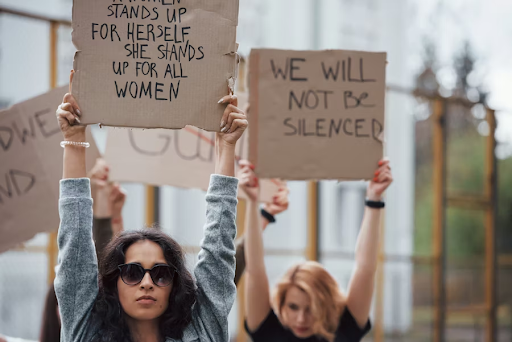


The first photo comforts me by acknowledging I demonstrate resilience when I participate in the weekly rallies designed to save our democracy. The second photo challenges me to always rely on my own resilience, even when faced with the most trying of circumstances; I may want to take advantage of the hand that reaches out to help, although that's still hard for me to do.
Which resilience photos will you choose? How will they comfort or challenge you?
As I write these words, I am deeply moved by the people of Minneapolis, who are manifesting resilience interdependently in a manner none of us has ever been seen before. They are creating a model of community resilience all of us can emulate. If our Northern California home is subjected to the same circumstances, I hope we will find similar ways to respond, embodying the "interdependence, collective versatility, and shared care" that Soraya Chemaly calls our "greatest resilience assets."
I am clearly a work-in-progress, so I've got more learning to do before I am truly embodying resilience. But this much I now know: resilience depends upon community, and community depends upon resilience. To be truly resilient, we need each other – now, more than ever before.
Lean on me
when you’re not strong
and I’ll be your friend,
I’ll help you carry on,
For
it won’t be long
‘til I’m gonna need
somebody to lean on.
– Hymn #1021 in Singing the Journey
Seeking a deeper dive into EMBODYING RESILIENCE?
Check out the one-page EMBODYING RESILIENCE Overview.
The complete *EMBODYING RESILIENCE ministry packet* is available to UUSM members and friends; to obtain the link, contact Sheila Sandow.


Comments